Air Gradia Flight 452
Station ElevenAir Gradia Flight 452 is the jet that arrives at Severn City Airport carrying passengers who will never emerge from it. As the airport’s community survives the Georgia Flu pandemic, the aircraft is kept sealed to protect those sheltering nearby from possible infection. It thus persists as more than an abandoned plane: a quarantine boundary, a site of unspoken loss, and a stark remainder of the air travel and global connection that the old world took for granted.
Arrival and Diversion
Clark Thompson boards the Toronto-bound flight at John F. Kennedy International Airport in the early days of the pandemic. It is the twenty-seventh-to-last plane to depart that airport. His journey is shaped by luck: infected people are already in the terminal, but he avoids them and the surfaces they have touched. He is exhausted, listening to Coltrane and preoccupied with Arthur Leander, and does not recognize Elizabeth Colton until she boards with her son, Tyler Leander.
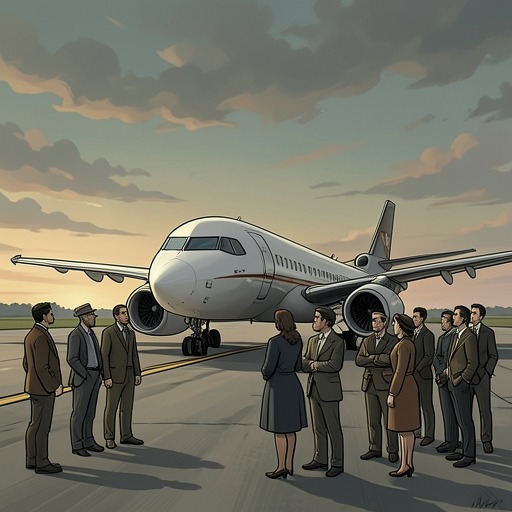
Clark had told Elizabeth his flight plans, and she had said she would try to take the same plane. They greet one another, then have little contact before the pilot announces a diversion to Michigan. The passengers disembark, confused, at Severn City Airport. The plane’s arrival brings Clark, Elizabeth, and Tyler into the same stranded community, but the aircraft itself will not become a means of escape. It stays on the tarmac while the airport’s ordinary systems and the wider world fail.
The Sealed Aircraft
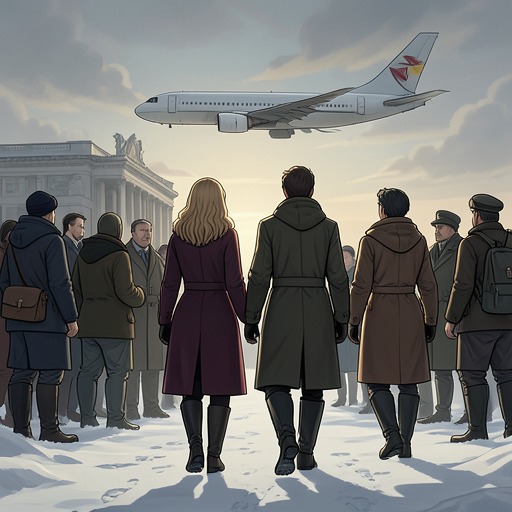
The plane remains alone on the tarmac as the airport empties of its normal activity. Snow covers the ground and the aircraft; there are no de-icing machines, tire tracks, or footprints, and the ground workers have left. No one emerges from the jet. As the crisis deepens, Clark tries not to look toward it and, at times, almost persuades himself that it is empty like the other aircraft outside.
The decision to keep Air Gradia Flight 452 sealed is made without ceremony. The survivors do not know whether the virus can be contracted from the dead, and opening the plane could expose a packed airport to a fatal contagion. The jet becomes a makeshift mausoleum, its dark windows keeping its occupants out of sight but not out of mind. The choice protects the living, yet its necessity is inseparable from the loss contained behind the doors. Clark later thinks of the decision, and of what enforcing it may have required, as something the airport community avoids discussing.
A Forbidden Presence
The sealed aircraft occupies a curious place in the survivors’ daily landscape: physically visible, but treated as off-limits and rarely spoken of. Its distance near the perimeter fence allows it to become the focus of ghost stories among the airport’s children. In Year Two, while breaking sticks for kindling, Clark thinks he sees a child beside the plane. He finds Tyler standing near its nose, reading aloud from a paperback.
Tyler explains that he is reading to the people inside. The passage he recites speaks of plagues, death, mourning, famine, and judgment. Clark knows that the plane is not empty, even as he tells Tyler that no one is inside. He understands that the dead remain aboard, and that the jet’s sealed stillness makes it an overwhelming presence. Tyler says that he wants the passengers to know their deaths happened for a reason; Clark answers that some things simply happen. Their exchange exposes a difference in how they interpret the catastrophe: Tyler reaches toward religious meaning, while Clark resists treating suffering as evidence of a plan.
Mobility Lost
The aircraft’s immobility gains force against the mobility associated with the world before the pandemic. Air travel once made distant cities and countries reachable; now borders stand unmanned, communications fail, and people who leave home may find roads blocked by abandoned cars. Kirsten Raymonde and her brother Peter first try driving out of Toronto, then have to continue on foot when the expressway ramps and side roads are clogged. Elsewhere, the Travelling Symphony’s caravans are converted pickup trucks pulled by horses after gasoline becomes unavailable. Air Gradia Flight 452, built for long-distance movement, remains grounded and inaccessible.
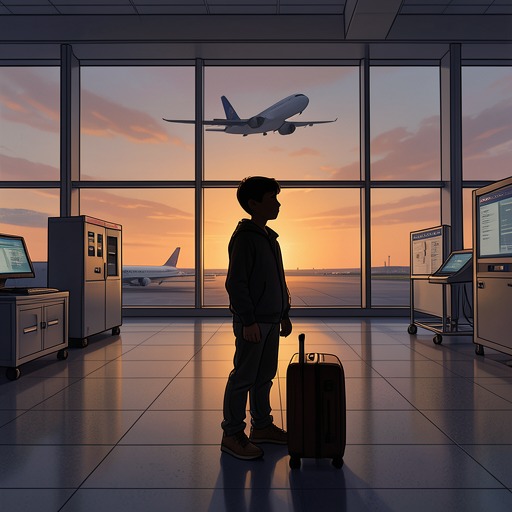
Across the ruined landscape, airplanes still exist but have lost their former purpose. They stand dormant on runways and in hangars, collecting snow or serving as places to store food. The contrast is not simply between a working machine and a broken one: flight had offered a view of distant lights and imagined lives, as well as a practical way to cross great distances. At Severn City Airport, the stranded jet holds that vanished possibility in place. It is a plane that can be seen but not boarded, its presence marking the difference between the capacity for movement and the ability to go anywhere.
Memory and Historical Evidence
The aircraft’s meaning shifts as the airport becomes a settled community. In Year Fifteen, children are taught about the machines that once crossed the skies and the electronic devices and worldwide networks that belonged to the same vanished systems of travel and communication. Airplanes and the Internet are now matters of instruction, difficult for students to imagine from description alone. The school’s lessons turn the airport landscape into evidence: the objects remain, while the practices and infrastructure that made them useful have disappeared.
For Clark, Air Gradia Flight 452 remains more than a lesson in obsolete technology. The plane is bound to the decision that kept its occupants sealed away from the living, and to the memories he tries to keep at a distance. It is both an immediate practical danger and a persistent reminder of the cost of safety. Its stillness gives the airport community a visible boundary between what can be protected and what cannot be recovered.